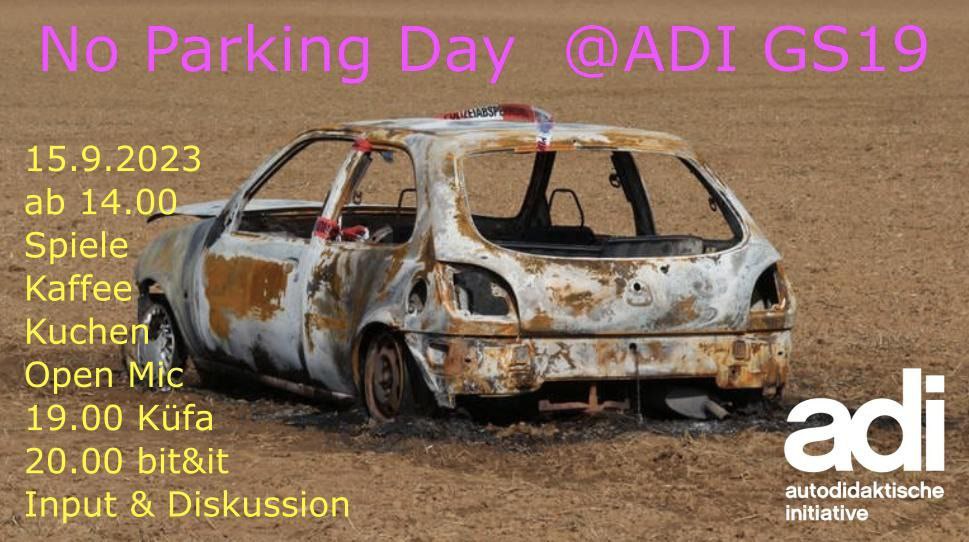
Es ist mal wieder soweit. Der PARK(ing) Day steht diesen Freitag wieder an und wir sind wieder dabei!
Dieses Mal erwartet euch folgendes: Um 14Uhr startet das Couch-Cafe (mit Kaffee und Kuchen) und eine Open-Mic-Session. Wir freuen uns u.a. voraussichtlich auf Texte aus dem Buch „revolutionäre Stadtteilarbeit“ verlesen von einem Mitglied der Kiezvernetzung West. Komm vorbei, bring einen Text mit, deine Lieblingspassage aus einem Buch, ein Instrumentalstück, dein Lieblingslied, deinen Lieblingswitz und teile dies mit der Georg-Schwarz-Straße. Außerdem erwartet euch eine Spieleecke, sowie Samenbomben herstellen. Am Abend um 20Uhr wird es eine Input zur künstlichen Intelligenz geben.
Wir freuen uns auf euch!
Eure adilettas und Nachbar*innen. 💙
Tagesprogramm
Ab 14h // Couch-Café: mit Kaffee, Tee, Kuchen und Open Mic:
Ab 19h // gibt es wie gewohnt leckkker Essen (Verzehr auf eigene Gefahr)
ab 20h // erwartet alle Interessierten ein Input zu Künstliche Intelligenz (Infos siehe unten)
Ab 21h // könnt ihr auch nochmal das Open Mic bespielen.
22h // ist Aufräumen angesagt. (Wir freuen uns über helfende Hände)
Diskussion Philosophie und digitale Welt & Input künstliche Intelligenz
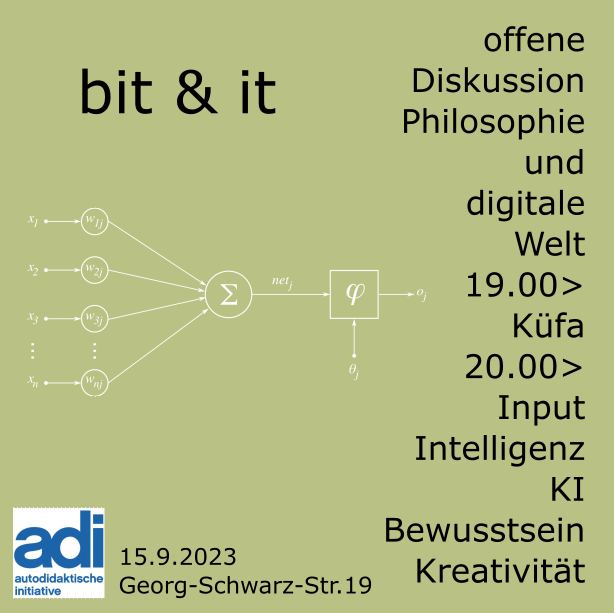
Themen wie Künstliche Intelligenz, Trans-/Posthumanismus, Simulationstheorie etc. werden aus einer linken Perspektive eher selten diskutiert. Dieser Abend soll ein erster Versuch sein in der ADI diesen Themenkomplex zu öffnen und ausloten welche Interessen und Bedürfnisse es gibt. Es wird einen kleinen Input geben der grob den Stand der Dinge in Bezug auf KI aufzeigt und eine Diskussion mit dem eventuellen Ergebniss neuer Topics für weitere Diskussionen.
Barrieren: Es gibt die Möglichkeit eine barrierarme, rollstuhlfreundliche Toilette zu nutzen und am kompletten Angebot teilzunehmen. Alle genutzen Flächen sind weitestgehend zugänglich für Rollstuhlfahrende.
Diskriminierung: Wir dulden keine diskriminierende, unreflektierte Sprache. Jeglichen Sexismus, Antisemetismus, Able-ismus, Transfeindlichkeit, Rassismus usw. ist von der Veranstaltung ausgeschlossen.